
 EN
EN



When engineers and procurement teams set out to build precision automotive gauges, the display component sits at the heart of every design decision. Selecting the right custom LCD panels directly shapes how accurately and reliably a speedometer, tachometer, or fuel gauge communicates real-time data to the driver. Custom LCD panels designed for automotive environments must meet far stricter standards than consumer-grade displays, making the sourcing process both critical and complex.
This guide walks procurement engineers and product developers through the essential considerations for sourcing custom LCD panels for precision automotive gauges. From selecting the right display technology to evaluating supplier capabilities, understanding these factors ensures that your custom LCD panels perform consistently across vibration, temperature extremes, and long service life demands typical of automotive applications. Every detail matters when custom LCD panels are integrated into vehicle instrument clusters.
Display Technologies for Automotive Custom LCD Panels
VA, STN, TN, and HTN Technology Options
Automotive gauge applications rely on several established LCD technologies, and choosing correctly between them is the first decision when sourcing custom LCD panels. VA (Vertical Alignment) custom LCD panels offer high contrast ratios and excellent black-state performance, making them well-suited for premium instrument clusters where visual clarity is a priority. STN (Super Twisted Nematic) custom LCD panels provide a broader viewing angle and are widely used in cost-sensitive gauge applications where reliable readability across angles is needed. TN (Twisted Nematic) custom LCD panels offer fast response times and low power consumption, which can benefit battery-sensitive or motorcycle gauge designs. HTN (High Twisted Nematic) custom LCD panels fall between STN and standard TN in terms of viewing angle and contrast, making them a flexible middle-ground choice for custom automotive segment displays.
When sourcing custom LCD panels, your engineering team should evaluate each technology against the specific viewing conditions, ambient lighting, and operating temperature range of the target gauge application. Custom LCD panels built on the wrong base technology will underperform no matter how well the rest of the assembly is executed. Matching the technology to the application is a non-negotiable foundation of effective custom LCD panels sourcing.
Segment vs. Graphic Custom LCD Panels
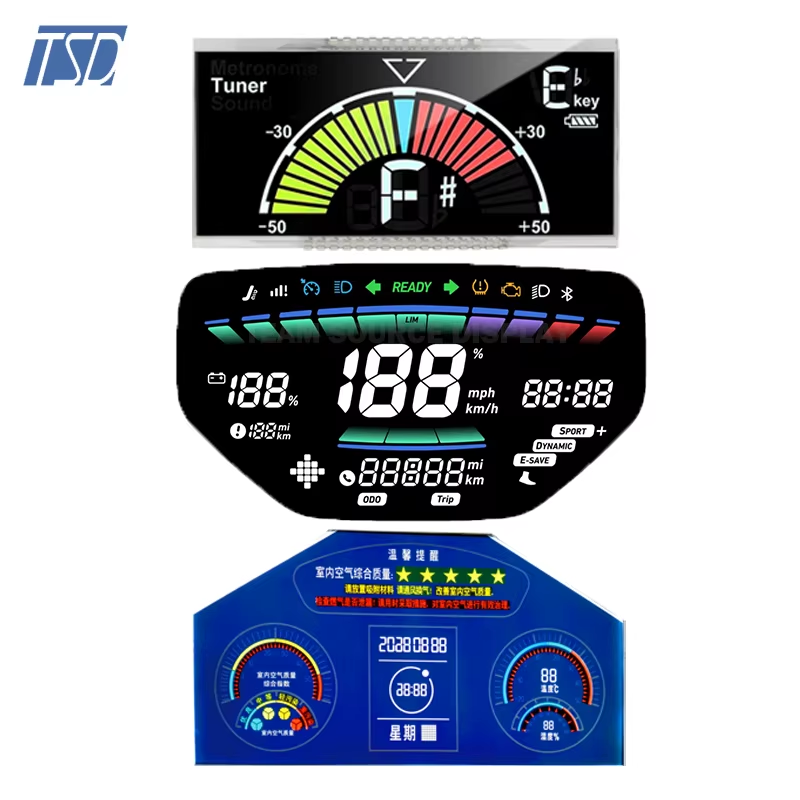
Automotive gauges most commonly use either segment or graphic custom LCD panels. Segment custom LCD panels display fixed numerical and symbolic information, such as speed digits or warning icons, through pre-defined electrode patterns. They are robust, power-efficient, and straightforward to integrate. Graphic custom LCD panels offer dot-matrix or full-graphic capability, allowing variable content and more complex visual layouts for modern multi-function instrument clusters. When sourcing custom LCD panels for precision gauges, determining whether your design calls for segment or graphic output early in the process will define supplier requirements, tooling needs, and unit pricing significantly.
Critical Specifications When Sourcing Custom LCD Panels
Shape, Size, and Custom Tooling
One of the defining characteristics of custom LCD panels for automotive gauges is the non-standard shape. Vehicle instrument clusters frequently require custom LCD panels with irregular outlines, curved edges, or cutouts to fit within styled gauge bezels. Sourcing custom LCD panels with custom shapes requires suppliers who maintain in-house tooling capabilities, since off-the-shelf glass cutting is insufficient for precision automotive work. When evaluating suppliers of custom LCD panels, confirm that they can produce custom-shaped glass, manage their own photomask fabrication, and offer low minimum order quantities appropriate for prototype validation phases. Custom LCD panels with fully custom shapes require longer lead times, so early supplier engagement is essential in any automotive program timeline.
Size tolerances for custom LCD panels in automotive gauges are tighter than in consumer electronics. A misaligned or undersized custom LCD panel introduces optical gaps or bezel fit failures that affect both appearance and seal integrity. Suppliers of quality custom LCD panels should provide dimensional drawings and tolerance specifications as part of their standard quoting process, allowing your mechanical engineers to validate fit before committing to tooling investment.
Temperature Range and Automotive-Grade Performance
Custom LCD panels for automotive applications must withstand a wide operating temperature range, typically from minus 30 degrees Celsius to plus 85 degrees Celsius or beyond. Storage temperature requirements for custom LCD panels are even broader. Standard commercial-grade custom LCD panels are not rated for this range and will exhibit contrast degradation, slow response, or failure under automotive thermal cycling. Specify automotive-grade custom LCD panels explicitly with your supplier, and request test data or qualification reports confirming that the custom LCD panels meet the required thermal performance. Some custom LCD panels also incorporate heater elements for guaranteed cold-start legibility, a feature relevant for motorcycles and vehicles used in cold climates.
Evaluating Suppliers of Custom LCD Panels
Supplier Capability and Qualification Process
Not every LCD manufacturer is equipped to produce custom LCD panels that meet automotive standards. When sourcing custom LCD panels for precision gauges, prioritize suppliers who demonstrate experience specifically with vehicular applications. A capable supplier of automotive custom LCD panels should be able to provide engineering support during the design phase, including electrode layout review for segment custom LCD panels or pixel matrix optimization for graphic custom LCD panels. Suppliers should also have cleanroom manufacturing environments to ensure that custom LCD panels are assembled without contamination that would cause visual defects in the final gauge.
Quality certification matters when sourcing custom LCD panels for automotive instruments. Suppliers producing custom LCD panels for vehicle dashboards should hold ISO 9001 certification at minimum, and ideally IATF 16949 or equivalent automotive quality management credentials. During supplier evaluation, request samples of existing custom LCD panels produced for automotive clients to assess workmanship, optical uniformity, and marking quality firsthand.
Prototyping and Lead Time Management
The sourcing cycle for custom LCD panels in automotive programs typically involves a prototype phase, an engineering validation phase, and a production phase. Each phase places different demands on the supplier of your custom LCD panels. During prototyping, the supplier must be able to produce small quantities of custom LCD panels quickly so that your team can validate fit and optical performance. During production scaling, the supplier must deliver custom LCD panels with consistent quality across larger volumes. Establish clear lead time expectations and milestone agreements with your supplier before custom LCD panels tooling is initiated. Well-managed lead times for custom LCD panels help prevent costly delays in vehicle program schedules.
FAQ
What makes custom LCD panels different from standard LCD panels for automotive use?
Custom LCD panels are designed to specific shapes, sizes, electrode patterns, and performance grades that standard off-the-shelf panels cannot match. For automotive gauges, custom LCD panels must also meet temperature, vibration, and longevity requirements that commercial-grade panels are not built for.
How do I choose between segment and graphic custom LCD panels for a gauge application?
Segment custom LCD panels are ideal when the display content is fixed, such as numeric speed or fuel level readouts. Graphic custom LCD panels suit applications requiring variable content or more complex visual layouts. Your choice of custom LCD panels type should align with the information architecture of the instrument cluster you are designing.
What lead times should I expect when sourcing custom LCD panels for automotive gauges?
Lead times for custom LCD panels vary by complexity. Tooling and first-article samples of custom LCD panels typically take six to twelve weeks. Production orders for custom LCD panels with established tooling generally require four to eight weeks depending on volume and supplier capacity. Early planning and supplier engagement are essential for keeping custom LCD panels delivery aligned with vehicle program timelines.